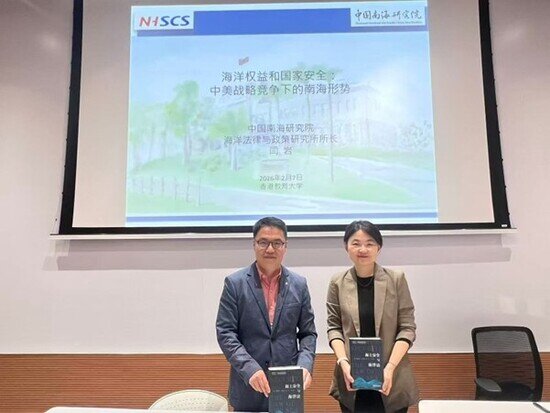
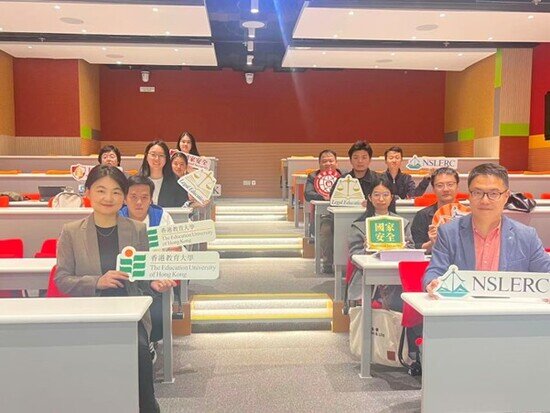
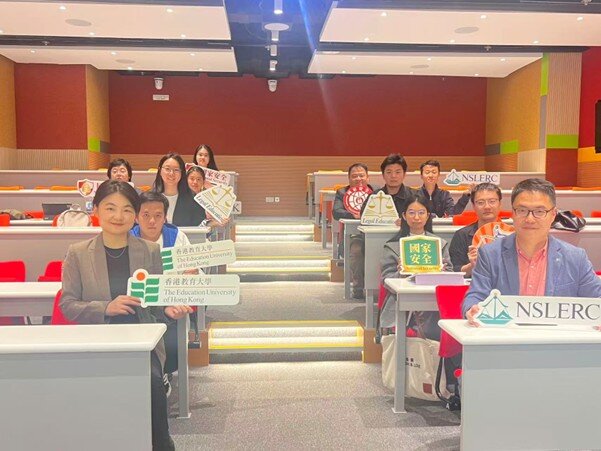
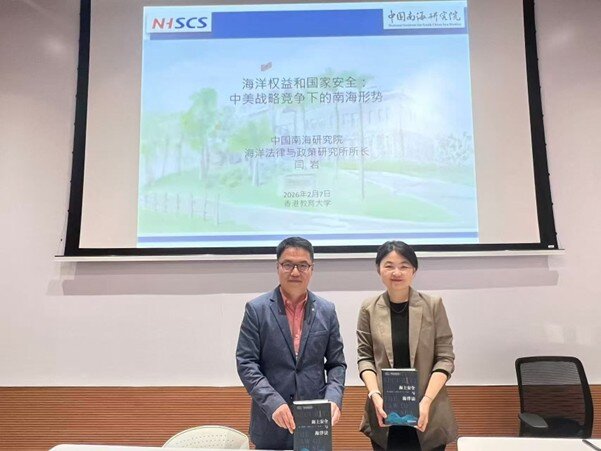
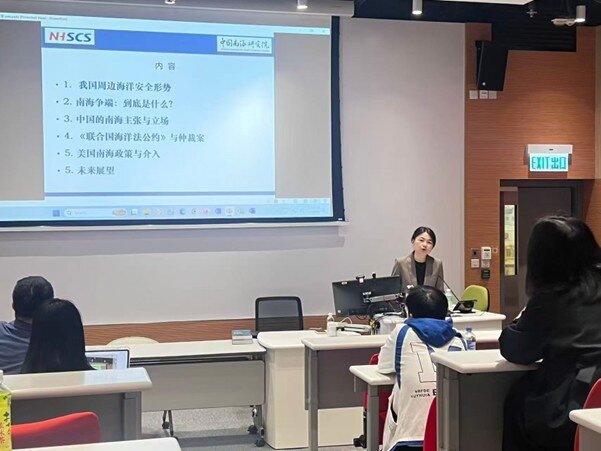
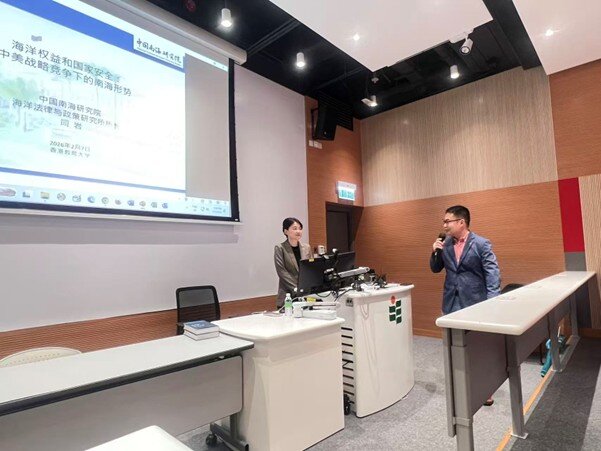
To enhance understanding among students regarding national security, international maritime law, and regional governance issues, the National Security and Legal Education Research Centre (NSLERC) of The Education University of Hong Kong (EdUHK) held a seminar titled “Maritime Rights and National Security: The South China Sea under China–US Strategic Competition” on 7 February 2026 at the Tai Po Campus. The event attracted students and staff members from the Master of Laws in Digital Governance [LLM (DG)] programme, fostering a vibrant atmosphere of academic exchange and reflecting the high level of concern regarding the South China Sea situation, regional security, and global governance.
The seminar was delivered by Dr. Yan Yan, Director of the Institute of Marine Law and Policy at the National Institute for South China Sea Studies and Deputy Director of the South China Sea Strategic Situation Probing Initiative. Dr. Yan holds a PhD in Law from the University of Hong Kong and a Master’s degree from the London School of Economics and Political Science. She has long been engaged in research on international maritime law and South China Sea issues, with extensive academic and policy research experience in marine legal policy, regional maritime security, and related national practices.
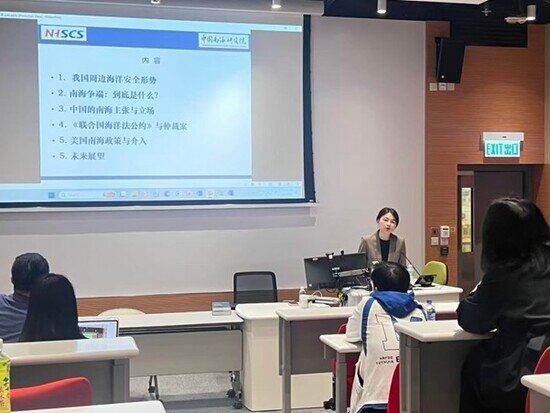
Analyzing the South China Sea Situation and Geostrategic Context
During the seminar, Dr. Yan analyzed recent developments in the South China Sea against the backdrop of intensifying strategic competition between China and the United States. She pointed out that the South China Sea is not only a critical global maritime corridor but also a geopolitically significant space where regional interests and great-power politics intersect. Although the overall situation in the South China Sea has remained relatively stable in recent years, she observed that regional friction and potential risks have gradually increased.
Drawing the case analyses, Dr. Yan highlighted that certain claimant countries have heightened tensions through expanding maritime law enforcement activities, strengthening construction on islands and reefs, and tightening control over relevant waters. Additionally, recent actions taken by the Philippines have further complicated the regional security environment. The United States also continues to enhance its military and political presence in the South China Sea through "freedom of navigation operations," embedding the South China Sea issue deeper into the broader US-China strategic competition framework.
Reviewing the Impact of the South China Sea Arbitration Case
Dr. Yan also reviewed the developments and implications of the South China Sea arbitration nearly a decade after the award was issued. She noted that the arbitration process deliberately avoided addressing the core issue of territorial sovereignty, which limited its effectiveness in facilitating a substantive resolution of disputes. Instead, the ruling has in some respects deepened divisions among the parties involved and contributed to the growing complexity of the legal and geopolitical dynamics surrounding the South China Sea.
Prospects for Regional Cooperation and Governance
In discussing potential pathways for future governance in the South China Sea, Dr. Yan emphasized that China and ASEAN countries share important responsibilities and common interests in maintaining regional peace and stability. All parties can gradually establish more institutionalized cooperation mechanisms through enhanced dialogue and collaboration in areas such as maritime security, resource development, crisis management, and regional rulemaking. She pointed out that advancing institutional arrangements such as the "Code of Conduct in the South China Sea" is significant for reducing the risk of misjudgments and maintaining regional stability.
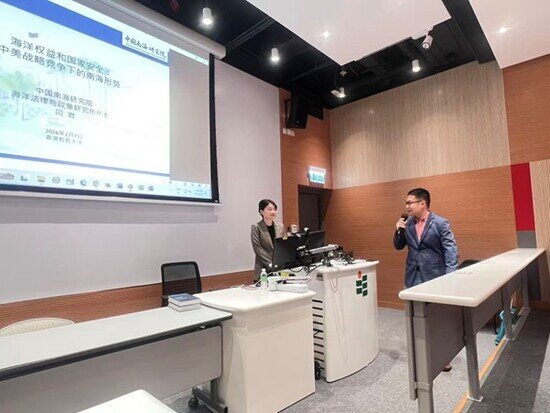
Interactive Exchange Deepens Academic Understanding
During the interactive discussion session, students and participants actively raised questions regarding the application of international law in maritime disputes, the implications of great-power competition for regional order, and the future trajectory of governance mechanisms in the South China Sea. Dr. Yan engaged in in-depth discussions based on her research and policy observations, further deepening participants' understanding of the multifaceted nature of the South China Sea issue.
Participants commented that the seminar provided both theoretical depth and policy perspectives, enhancing their understanding of the South China Sea and maritime law issues, as well as offering important insights into the interactions between national security, international law, and regional politics.
The National Security and Legal Education Research Centre (NSLERC) of EdUHK will continue to organize academic events and invite experts from around the world to share their research and insights, fostering interdisciplinary exchange on issues concerning national security, international law, and global governance.